
Awaab’s Law has deadlines. Can you prove you’re meeting them?
Well Homes keeps every statutory clock in view for councils and housing associations, from a tenant’s first report to the evidence pack.
Built in line with the Hazards in Social Housing Regulations 2025
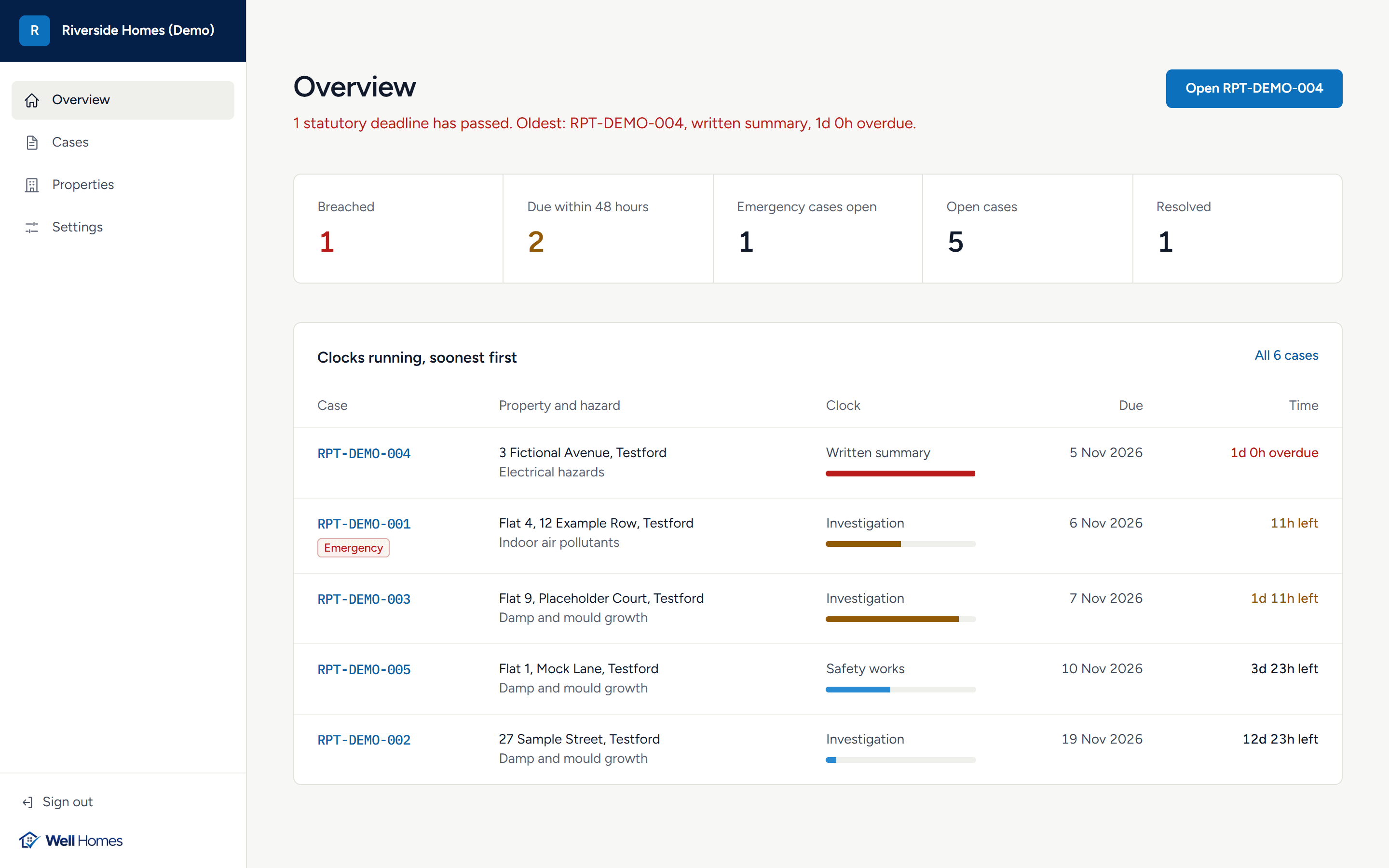
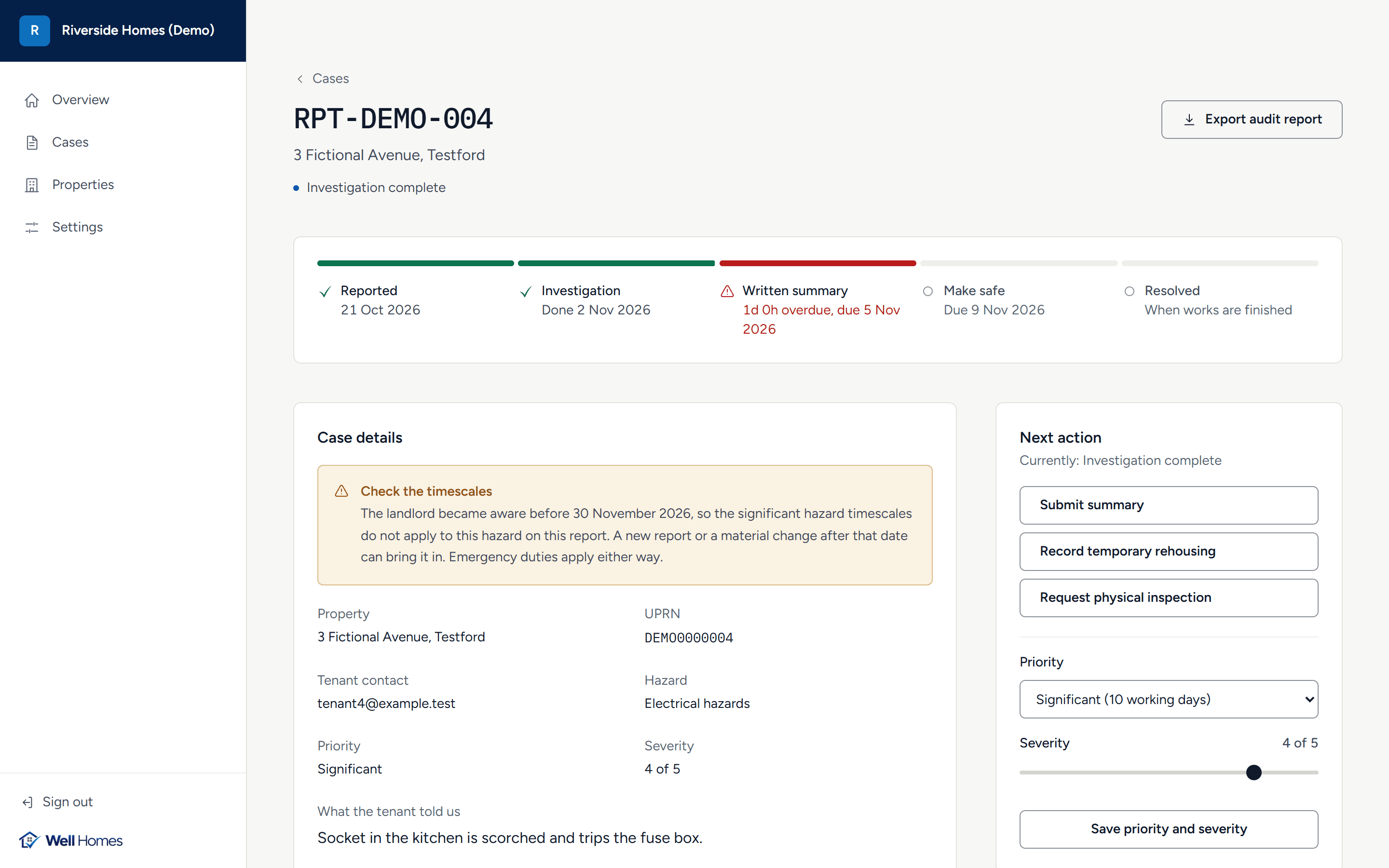
Written summary
19:00:00 overdue
Emergency, make safe
08:15:12 left
Walkthrough
See a case, from report to record
Under a minute, with the captions on screen. There is no sound.
The law
The deadlines the law sets
Awaab’s Law covers councils and housing associations in England, under the Social Housing (Regulation) Act 2023. Its deadlines are terms of the tenancy, so a tenant can enforce them in court and complain to the Housing Ombudsman.
- 24hours
- to investigate an emergency hazard and make it safe
- 10working days
- to investigate a significant hazard
- 3working days
- after the investigation, for a written summary to the tenant
- 5working days
- after the investigation, to make safe and begin preventative work
Since 27 October 2025
Damp, mould and fungal growth, and every emergency hazard except overcrowding.
Due from 30 November 2026
Excess cold and heat, falls, structural collapse, fire and explosions, electrical hazards, and domestic hygiene. Fire risks in the shared parts of a block are excluded. These regulations were still in draft when we last checked, on 6 November 2026.
Planned for 2027
All remaining hazards in the Housing Health and Safety Rating System, except overcrowding.
See every duty, for each type of hazard
| Duty | Emergency hazard | Significant hazard |
|---|---|---|
| Investigate | Emergency hazard: 24 hours | Significant hazard: 10 working days |
| Make safe | Emergency hazard: 24 hours | Significant hazard: 5 working days after the investigation |
| Written summary to the tenant | Emergency hazard: 3 working days after the investigation | Significant hazard: 3 working days after the investigation |
| Begin preventative work | Emergency hazard: 5 working days after the investigation | Significant hazard: 5 working days after the investigation |
| Latest start, if steps are under way | Emergency hazard: 12 weeks | Significant hazard: 12 weeks |
| In-person inspection, if the tenant asks | Emergency hazard: Within the 24 hours where needed | Significant hazard: 10 working days from the request |
If safety work cannot be finished in time, the landlord must offer suitable alternative accommodation at its own cost until it is. Working days exclude weekends, Christmas Day, Good Friday and bank holidays in England and Wales.
Readiness check
What you’re doing today might not be enough
The law asks you to show what you did, and when. Answer these six questions honestly: could you evidence each one today?
Can you show the date and time you first became aware of each hazard?
Do you know which working day every investigation must finish, allowing for bank holidays?
Could you show every tenant got a written summary within 3 working days of an investigation?
Could you make an emergency hazard safe within 24 hours, and prove that you did?
If safety work ran late, could you show that suitable alternative accommodation was offered?
Are your team ready for the hazards due to be added on 30 November 2026?
How it works
From report to evidence
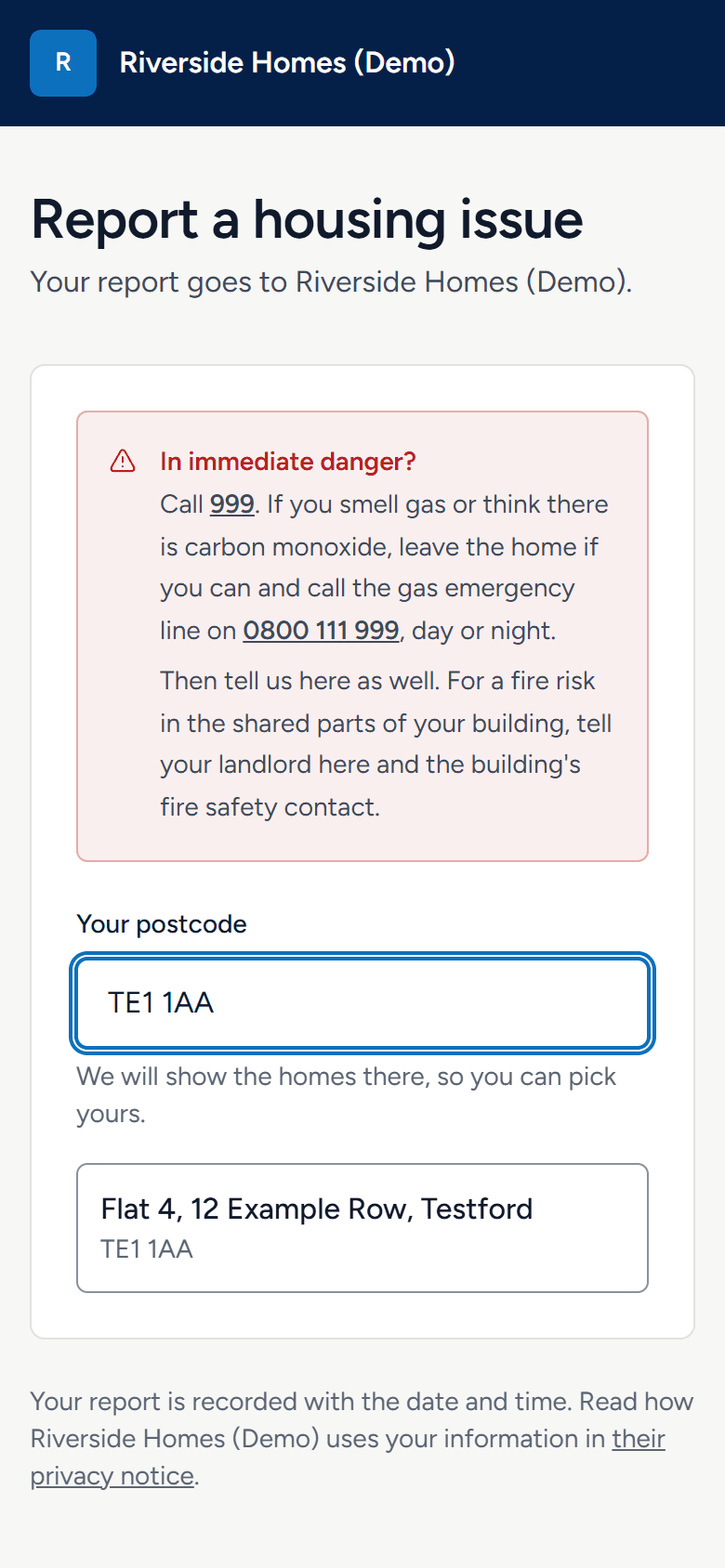
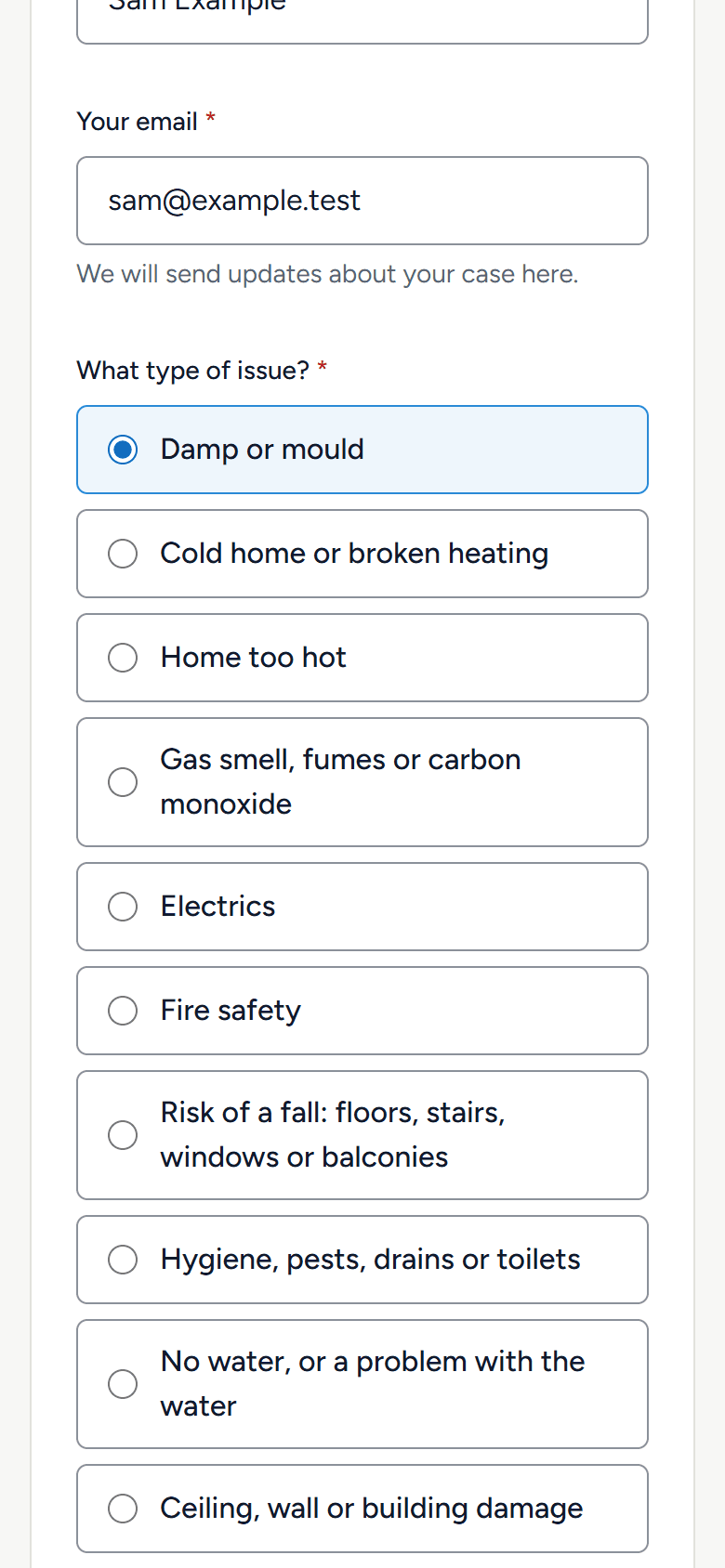
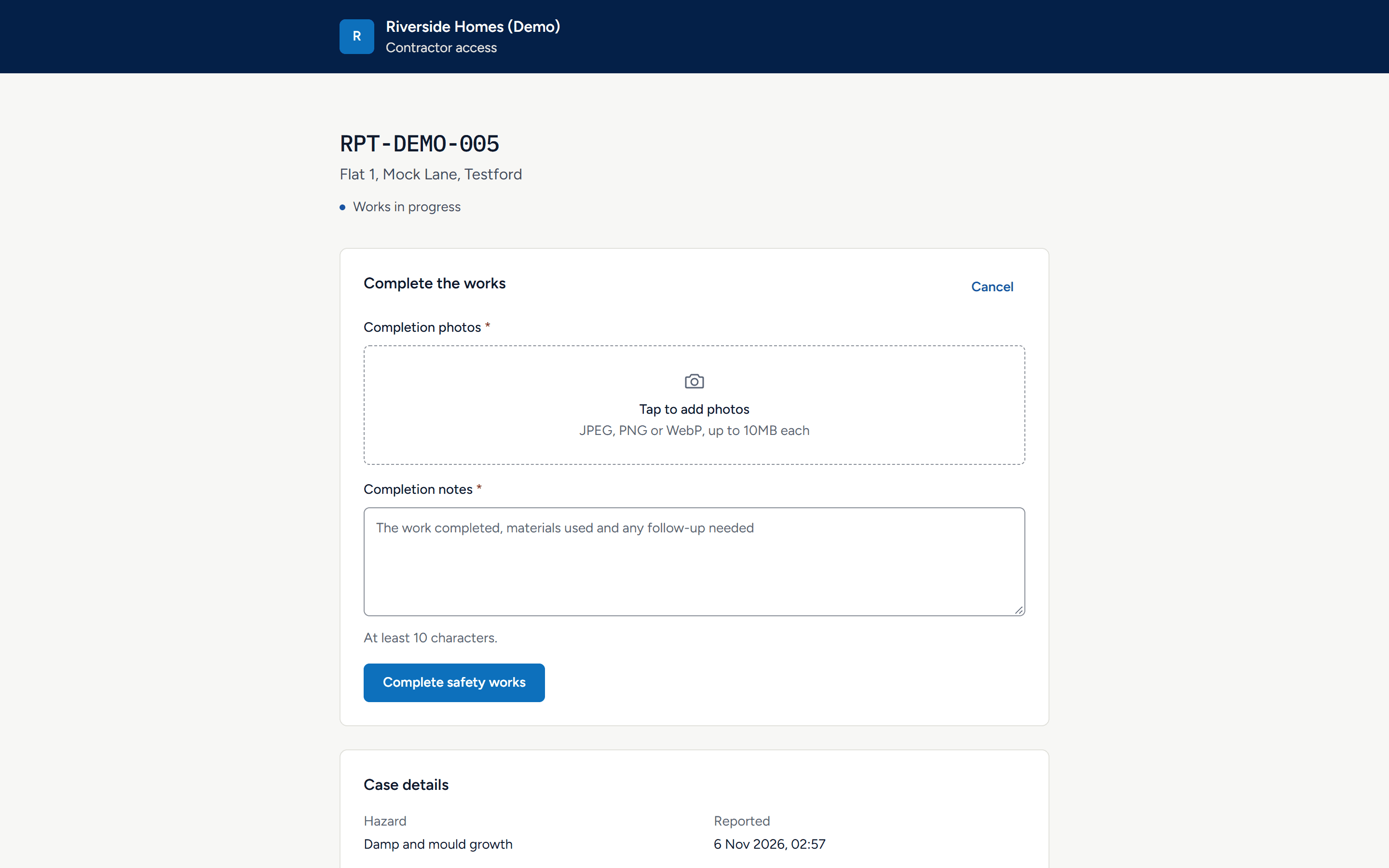
Three steps. No app for your tenants, and nothing for them to sign in to.
Product
What your team gets
Statutory deadline engine
24 hour, 10 day, 5 day and 3 day periods worked out from the moment of awareness, with bank holidays excluded.
AI assessment, human decision
AI reads the tenant's photo and sets a provisional hazard and priority. Staff must acknowledge it before the case moves on, and its original output is kept.
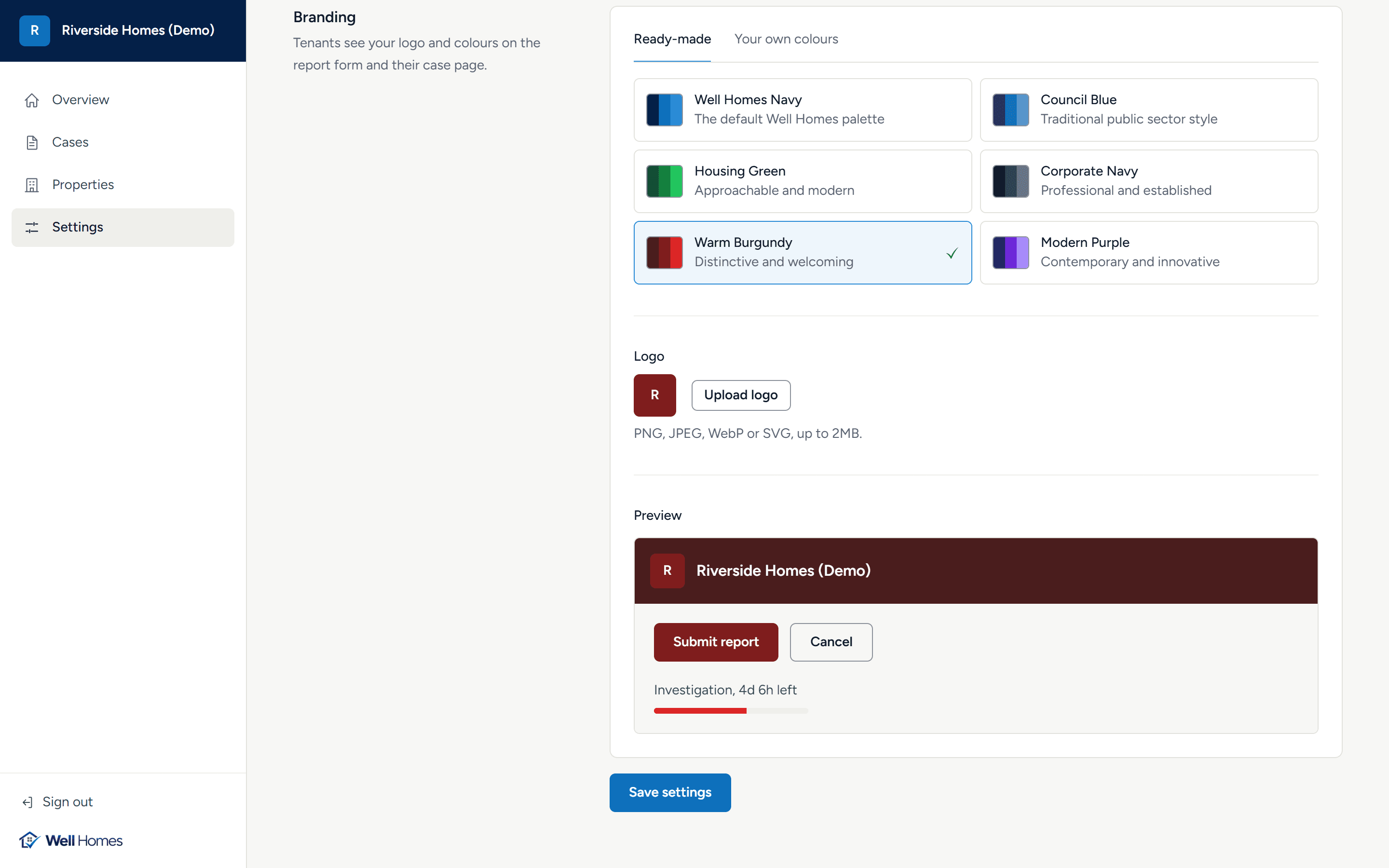
Your name on it
Your colours and logo across the tenant form, staff portal and evidence pack.
Alerts before a breach
Emails to your team as each deadline approaches, with repeat alerts once it has passed.
Contractor access
A time-limited link for each contractor, who sees the one case and uploads completion photos without an account.
A case view for the tenant
A private link shows the tenant where their case stands and what is due next.
The difference
What changes for your team
Today
- Deadlines counted by hand, in spreadsheets that do not know the bank holidays
- Evidence scattered across email threads and shared drives
- Case history that leaves when a member of staff does
- Days spent assembling a file before an ombudsman review
With Well Homes
- Deadlines worked out from the moment of awareness, with bank holidays excluded
- Every action held in one append-only timeline
- The record stays with the case, whoever works on it
- A case's full record ready to print
What comes next
Awaab’s Law first. Your whole property record next.
We start with tenant safety because the law does. Over time, the same record is planned to grow into a full property management system.
Today
Available- Tenant hazard reports
- Statutory clocks and alerts
- Permanent audit trail
- Contractor access
- Evidence pack
Down the line
Planned- Energy Performance Certificates (EPCs)
- Wider property compliance records
- One property management system
Plans, not features you can buy today.
Why it matters
This is about keeping people safe at home
Awaab's Law is named after Awaab Ishak, who was two years old when he died in 2020 after prolonged exposure to mould in the home his family rented in Rochdale.
We built Well Homes because the people responsible for tenants' safety should not have to run those duties from spreadsheets and email. Well Homes handles the tracking, the calculation and the record. Your team handles the repairs.
Questions
Common questions
Who does Awaab's Law apply to?
Social landlords in England: councils and private registered providers such as housing associations. Councils also keep their separate 24 hour repair duties under the Right to Repair Regulations, and the shorter period applies.
When does the clock start?
On the day you become aware of a potential hazard, including through a third party such as a managing agent. Working day periods begin on the next working day. Emergency hazards run for 24 hours.
Which hazards are covered?
Today, damp, mould and fungal growth where they pose a significant risk, and all emergency hazards except overcrowding. The government plans to widen the list from 30 November 2026 to excess cold and heat, falls, structural collapse, fire and explosions, electrical hazards and domestic hygiene, leaving out fire risks in the shared parts of a block. Those regulations were still in draft when we last checked, on 6 November 2026. All remaining hazards except overcrowding are planned for 2027.
Does a tenant need an account?
No. They scan your QR code or open your link, find their address and submit. They then receive a private link to follow their case.
Does the AI decide what is an emergency?
If a landlord turns it on, it sets a provisional hazard and priority from the tenant's photo. Your staff must acknowledge that assessment, and they can raise the priority. Once a case is an emergency it cannot be downgraded.
Does Well Homes replace legal advice?
No. It helps you meet and evidence your duties. Decisions about a hazard, and whether you have met the law, remain yours.
Try it
Try the clock on your own dates
Pick the day you became aware of a hazard, and see what falls due and when.
| Duty | Due by |
|---|---|
| Investigate10 working days from becoming aware, reg 6 | Wed, 25 Nov 2026 |
| Written summary to the tenant3 working days after the investigation, reg 9 | Mon, 30 Nov 2026 |
| Make safe5 working days after the investigation, reg 11 | Wed, 2 Dec 2026 |
| Begin preventative work5 working days after the investigation, reg 13 | Wed, 2 Dec 2026 |
| Latest start, if steps are under way12 weeks after the investigation, reg 13 | Wed, 17 Feb 2027 |
See Well Homes in 30 minutes
We will show you how the deadline engine works, walk through the audit trail and answer your compliance team's questions.
Step 1
A 30 minute walkthrough
We go through the platform against the way your team works, with no commitment.
Step 2
Your property data
A CSV of your properties and UPRNs, and the email addresses of your staff.
Step 3
An onboarding call
We set up your organisation, your branding and your QR code with your team.